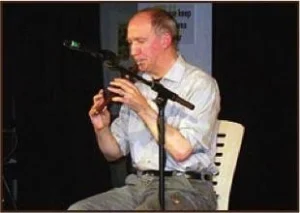
Stuart Campbell has started working on the handmade guitar he is donating to Folk at the Salmon Bothy, which will be raffled to raise Club funds.
Tickets £10 each available from Bob Philips or at any of our forthcoming events. Maximum of 250 tickets available. Draw will take place at the Haal in June.
Here’s Stuart’s second update on progress so far…
Neck, back, sides and top
… no, not physio health advice, these are the parts that I’ve been working on since the last update.
I was looking for a piece of timber at Logie Timber Sawmill for the neck, when Olly (the hardwood specialist) showed me some rippled sycamore (sometimes called flame maple). It was beautifully figured and, well, who could resist a piece of wood as stunning as this (not me)! It’s a particularly strong wood and is often used for necks. I also thought the pale honey colour would contrast well with the walnut body.
The neck is actually a laminate of sycamore / ash / sapele – to make it stronger. All the neck components were cut at the Boat Shed in Portsoy.

I really appreciate being allowed the use of their industry-quality tools (band-saws, table-saws, planner, etc) – it makes life a whole lot easier.
The sycamore was not a perfectly quarter-sawn piece; the grain runs at about 85° (it should be perpendicular), but the other two pieces compensate for that – but read on for a bit more on making the neck rigid…

The wood ‘sandwich’ was glued and clamped, then left for a couple of days before the next stage in turning a big lump of wood into a fine neck.

A slot, 6mm wide by 8.5mm deep, needs to be cut to take the dual-action truss-rod. To be honest, I’ve got a love / hate relationship with power tools, especially routers. Sure, I could chisel out this slot by hand, but in wood this hard it would take hours and hours. The trouble with power tools is that you get virtually zero feedback from the wood, you just don’t know what’s going on; and they’re not forgiving. They also need to be set up precisely – in this case to cut exactly straight down the middle.
In order to get the exact depth (the truss-rod has to be a flush fit) it’s necessary to make half a dozen (or more) passes with the router, removing just a little bit each time. When that’s done, you can breathe… then repeat the process (twice) to cut two 3mm x 6mm slots to take carbon fibre reinforcing rods. I decided to fit these as an additional precaution against any chance of the neck bending – they’re so dense and hard that they need to be cut with an angle-grinder.

Then it was back to the Boat Shed to cut the neck to its rough shape. A lot of folk are now using CNC machines to make finished necks (and other parts) – including some luthiers who are making very expensive ‘hand built’ guitars. While I have to acknowledge there’s skill involved in designing these necks, etc., and a lot of know-how in setting up the machines, I also wonder at what point can you still claim they’re ‘hand’ made… or maybe I just wish I had a Computer Numerical Controlled machine… Oh, just in case you’re wondering, the ‘waste’ material from the neck will probably be turned (literally) into a bowl.

… and back to the bench to rough out the back of the neck (by hand and eye!). I use the ‘facet’ method – in essence, cutting the neck to a octagonal profile. I’ve been using a Japanese Shinto rasp for this job – they cut very efficiently without needing to use much force. It’s always easy to get carried away doing this sort of thing and inadvertently remove too much material (I think it’s because it’s rhythmic), so I use masking tape to mark up the area to be cut – when you start to feather the tape, STOP!

Also, since my last post, I turned my attention to the woods for the back and sides; and the soundboard. I had said the photos showed what the back of the guitar might look like. Well… I spent a good bit of time just looking and trying to see what the wood was telling me.. and it said ‘change around the boards’… So I did and I think the boards I’ve settled on for the back look better – and consequently the boards for the sides are probably going to be easier to bend (that might be famous last words…).

I cut these boards to a more manageable size at the Boat Shed; and did the same with the top ones.

Back at the bench the boards were book-matched to get the figure of the walnut to line up so that the back boards would be as near to a mirror image as possible. The same process was used to line up the sides. The two sides of the soundboard required the use of a magnifying glass to match the grain, because it’s quite fine.

The sides were clamped and planed square. The back boards and the soundboards were put on a shooting board in order to plane them square and straight, so that when they’re joined, edge to edge, there’s absolutely no gap.


Next time… probably more work on the neck and maybe a start on the dark art of making the internal braces…